Nvidia's Next-Gen AI Rack Slips a Year to 2028 — Nvidia Says That's Wrong
SemiAnalysis says Nvidia's Kyber AI rack slipped a year to 2028 over a 78-layer circuit board it can't yet build at scale. Nvidia denies it.
On this page
For a company that has spent two years selling cloud providers on a promise of relentless, clockwork annual upgrades, Nvidia just got a very public gut-check on one specific product — and answered it in a single sentence.
What exactly did SemiAnalysis report?
SemiAnalysis says Kyber, Nvidia’s next rack-scale system, won’t ship on schedule. The firm’s July 6, 2026 report claims the rack — built around an NVL144 configuration that packs 144 Rubin Ultra GPUs into a single vertically oriented cabinet, double the 72-GPU density of today’s NVL72 — has slipped from its original second-half-2027 launch alongside the Vera Rubin Ultra platform to 2028. That’s a delay of more than 12 months on a product Nvidia hadn’t yet shipped.
The chips themselves aren’t reportedly the problem. SemiAnalysis’s account puts the blame on the rack’s plumbing: a PCB “midplane” — the board that physically and electrically connects compute trays across the cabinet — built with 78 layers, which the firm describes as among the most complex PCBs ever designed for a commercial computing product.
Why can’t Nvidia manufacture a 78-layer board?
Because at that layer count, the board stops being a routine manufacturing job and becomes a yield problem. SemiAnalysis’s reporting cites challenges spanning signal integrity, power delivery, thermal design, and simply how many layers can be reliably manufactured at volume. Each is a known failure mode for high-layer-count PCBs, but Kyber’s 78 layers reportedly push past what suppliers can build with acceptable yield — meaning Nvidia can design the board, but can’t yet make enough working units to fill a data center’s worth of racks.
It’s worth being precise about what’s allegedly late. SemiAnalysis’s report concerns the enclosure — the physical rack, power delivery, and interconnect board that houses Rubin Ultra GPUs — not the GPUs themselves. Nvidia’s chip cadence and its rack-scale manufacturing cadence run through different supply chains, and this report only implicates one of them.
SemiAnalysis also flagged that Nvidia’s larger NVL576 system could face delays or ship in limited initial volumes — suggesting the midplane problem isn’t isolated to one SKU but to the manufacturing approach Nvidia is scaling across its next rack generation.
What happened to Nvidia’s backup plan?
It reportedly died on contact with customers. SemiAnalysis says Nvidia had a stopgap ready in case the 78-layer midplane wasn’t ready in time: NVL72x2, which bolted together two of today’s NVL72 racks to approximate Kyber’s compute density without needing the new board. Cloud providers and hyperscalers — the customers who’d actually have to rack, power, and cool the thing — reportedly rejected it as operationally awkward and prohibitively expensive. Nvidia scrapped it rather than force it into production.
Kyber NVL144 slips from second-half 2027 to 2028 — over 12 months late — because its PCB midplane can’t be manufactured reliably at scale. The NVL72x2 stopgap was canceled after cloud customers rejected it as awkward and costly.
An Nvidia spokesperson denied the report on July 6, 2026, saying “our roadmap is intact.” Nvidia reaffirmed its near-annual release cadence, including the standard Vera Rubin platform still targeted for the second half of 2026.
Why did Nvidia deny it — and should you believe the denial?
Because a one-year rack slip is exactly the kind of headline Nvidia can’t afford to let sit uncontested. Nvidia has built its market position on relentless, predictable annual upgrades — Blackwell, then Blackwell Ultra, then Vera Rubin, then Rubin Ultra — sold to cloud customers who plan multi-billion-dollar data center buildouts years ahead around that cadence. A credible report that the rack, not the chip, is running a year behind threatens the one thing Nvidia sells alongside silicon: certainty.
Nvidia’s denial, though, is notably narrow. The company said its “roadmap is intact” — a statement about the overall cadence, not a line-by-line rebuttal of SemiAnalysis’s specific claims about the 78-layer midplane, the NVL72x2 cancellation, or the 2028 target. Nothing in Nvidia’s response, as reported, offers its own Kyber ship date or directly addresses the manufacturing-yield problem SemiAnalysis describes. That gap between a categorical denial and a specific rebuttal is worth sitting with.
What does this mean for developers and cloud customers?
It means anyone planning infrastructure around Kyber-class density should treat 2027 as optimistic, not committed. Enterprises and cloud providers building capacity plans around 144-GPU-per-rack density — density that reshapes networking topology, power provisioning, and cooling design, not just chip counts — now have two conflicting signals to plan against: an analyst firm’s detailed technical account of a real manufacturing constraint, and a vendor’s blanket reassurance with no specifics attached.
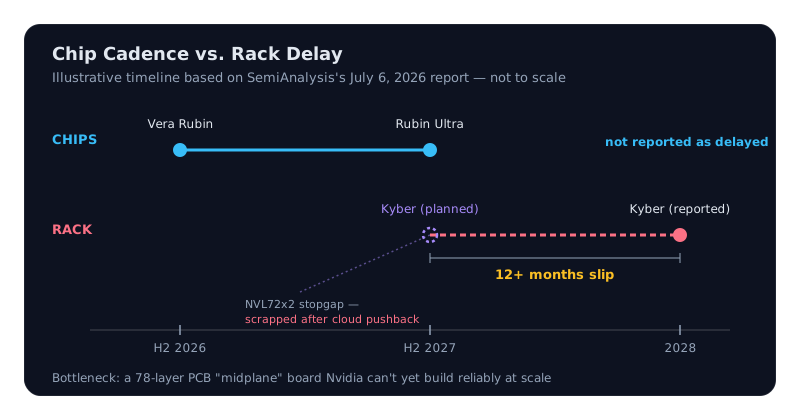
| Component | Original plan | SemiAnalysis report (Jul 6, 2026) |
|---|---|---|
| Vera Rubin platform | H2 2026 | Not reported as affected |
| Rubin Ultra chips | H2 2027 | Not reported as delayed |
| Kyber NVL144 rack | H2 2027 | Slips to 2028 (12+ months late) |
| NVL72x2 stopgap | Contingency plan | Reportedly canceled |
This kind of rack-scale bottleneck lands downstream of the same data center power and infrastructure strain already stretching hyperscalers thin — a delayed rack doesn’t just push out one product launch, it pushes out every capacity plan built on top of it. It’s also a reminder that AI infrastructure risk increasingly sits in unglamorous places: not the GPU die, but the board wiring 144 of them together, and the supply chain — from PCB fabricators to chip suppliers riding the AI cycle — that has to build it at volume.
Do
- Budget contingency time if your capacity plan assumes Kyber-class rack density in 2027
- Track chip availability (Rubin Ultra) and rack availability (Kyber) as separate risks
- Ask vendors for specifics — ship dates, yield data — not just cadence reassurances
Don't
- Assume a scrapped stopgap (NVL72x2) implies a firm date for the real product
- Treat “roadmap is intact” as a rebuttal of a specific manufacturing claim it doesn’t address
- Conflate a reported rack-scale delay with a chip-generation delay — they’re different supply chains
Who’s actually right here?
Nobody outside Nvidia and its board suppliers currently knows for certain, and that’s the real story. SemiAnalysis’s account is detailed enough — a specific layer count, specific failure modes, a named stopgap design and a stated reason customers rejected it — that it reads like sourced reporting on a real engineering constraint, not speculation. Nvidia’s response is real too, but it answers a different question: whether the company’s overall multi-year cadence is intact, not whether one specific rack ships on the date SemiAnalysis says it won’t. Until Nvidia offers a specific Kyber ship date or directly disputes the 78-layer claim, both things can be true at once — the roadmap stays “intact” in Nvidia’s telling while one product on it quietly moves a year to the right.
Frequently asked questions
What is Nvidia's Kyber rack system?
Kyber is Nvidia's next-generation rack-scale server design, built to pack 144 Rubin Ultra AI chips (an NVL144 configuration) into vertically oriented cabinets — double the density of today's NVL72 racks. It was originally planned to ship alongside the Vera Rubin Ultra platform in the second half of 2027.
Why is Kyber reportedly delayed to 2028?
Research firm SemiAnalysis says the delay traces to Kyber's PCB 'midplane' — a 78-layer circuit board connecting the rack's compute modules — that Nvidia can't yet manufacture reliably at scale, citing signal-integrity, power-delivery, and thermal-design problems on one of the most complex PCBs ever built commercially.
What happened to Nvidia's backup plan for Kyber?
SemiAnalysis reported Nvidia built a stopgap design, NVL72x2, that bolted together two current-generation NVL72 racks to approximate Kyber's density. Cloud providers and hyperscalers reportedly rejected it as operationally awkward and too costly, so Nvidia scrapped the workaround instead of pushing it into production.
How did Nvidia respond to the delay report?
The same day the report published, July 6, 2026, an Nvidia spokesperson denied it, saying 'our roadmap is intact.' Nvidia has not publicly disputed the specific technical details SemiAnalysis cited, instead reasserting its broader near-annual release cadence, including the standard Vera Rubin platform still slated for the second half of 2026.
Does the Kyber delay affect Nvidia's Rubin Ultra chips themselves?
No — the reported delay applies to the Kyber rack-scale enclosure, not the Rubin Ultra GPUs inside it. SemiAnalysis's report concerns the 78-layer midplane board's manufacturability, a separate supply chain from chip production. The firm also flagged Nvidia's larger NVL576 system as facing possible delays or limited initial volumes.
Sources & further reading
- CNBC — Nvidia's next-gen AI rack system delayed to 2028 on manufacturing snags, SemiAnalysis says
- Tom's Hardware — Nvidia's Kyber rack for Rubin Ultra slips to 2028
- Roic.ai — Nvidia reaffirms AI chip roadmap, rejects delay reports
- Seeking Alpha — Nvidia's next-gen Kyber AI rack delayed to 2028 on manufacturing snags: report
/* Comments */
Comments are offline right now — we reconnect automatically, nothing is lost.