SK Hynix Just Pulled Off the Biggest Foreign IPO in US History
SK Hynix raised $26.5 billion in a Nasdaq debut that beat Alibaba's IPO record, riding the AI memory-chip boom to a 13% first-day pop.
On this page
For one Friday in July, the biggest story on Wall Street wasn’t a chatbot company or a chip designer — it was the company that makes the memory those chips sit next to. SK Hynix, South Korea’s second-most valuable firm, rang the opening bell on Nasdaq on July 10, 2026 and walked away with $26.5 billion, the largest sum ever raised in a US listing by a foreign company. Alibaba held that record for twelve years. It took an AI memory shortage to break it.
How big was SK Hynix’s Nasdaq debut, exactly?
Big enough to rewrite the record book twice over. SK Hynix priced 177.9 million American depositary receipts at $149 each — a 2.7% premium to its three-day average price in Seoul — to raise $26.5 billion. That’s the largest US listing ever completed by a non-American company, surpassing the $25 billion Alibaba raised in its 2014 Nasdaq debut, a record that had stood for over a decade.
It’s also, per Bloomberg, the second-largest share sale in US history, period — trailing only SpaceX’s roughly $86 billion raise the prior month. Demand wasn’t close to a coin flip either: orders reportedly covered more than seven times the shares on offer before the deal even priced, according to TechCrunch.
| Offering | Year | Amount raised | Standing |
|---|---|---|---|
| SpaceX | 2026 | ~$86.0B | Largest all-time US share sale |
| SK Hynix | 2026 | $26.5B | Largest-ever foreign IPO in US history |
| Alibaba | 2014 | $25.0B | Previous foreign-IPO record (held 12 years) |
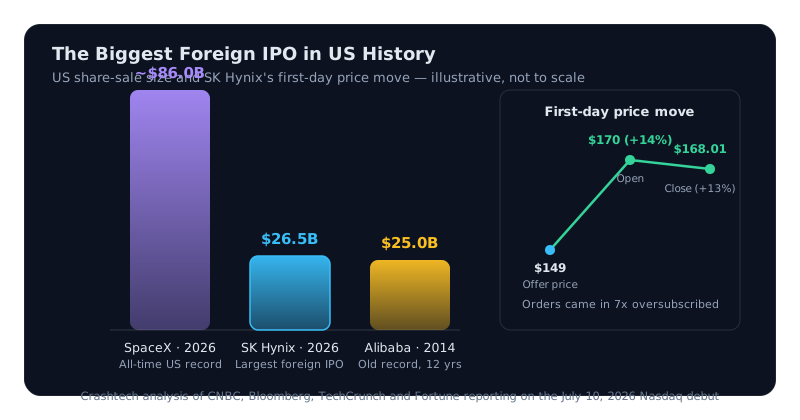
Trading opened Friday under the temporary ticker SKHYV at $170 — a 14% pop over the $149 offer price — before the stock settled to close the session at $168.01, up roughly 13% on the day. The permanent ticker, SKHY, takes over for regular trading. Bloomberg had modeled the ADRs opening as much as 17% above offer; the market landed a few points short of that indication but still delivered a clean first-day win for anyone who got an allocation.
Here’s the tension nobody’s pretending doesn’t exist: SK Hynix’s own filing earmarks the $26.5 billion for a new fabrication facility, a new packaging facility, and EUV lithography scanners — all located in South Korea. That’s happening at the exact moment US Commerce Secretary Howard Lutnick has been publicly pushing SK Hynix and Samsung to build memory-chip factories on American soil. Wall Street cash, Korean concrete — for now.
Why did investors oversubscribe by 7x?
Because SK Hynix isn’t selling a story — it’s selling audited profit tied to a chip Nvidia literally cannot ship AI processors without. The company controls roughly 60% of the global high-bandwidth memory (HBM) market, the specialized memory stacked directly onto AI accelerators to keep them fed with data fast enough to be useful. In 2025, that translated into about $64.1 billion in revenue and $28.3 billion in net income — a 44% net margin, per Fortune.
That’s a strikingly different money story than the one dominating headlines on the model-building side of AI, where even the biggest labs are burning far more cash than they take in. SK Hynix isn’t betting on AI paying off eventually — it’s already being paid, today, in dollars, for the physical bottleneck underneath every GPU cluster.
Executives leaned into that scarcity story rather than downplaying it. SK Group Chair Chey Tae-won said the company has “announced plans to double production capacity within five years, but every customer says, ‘That’s still not enough — we need more,’” according to Fortune. CEO Kwak Noh-jung went further, telling the same outlet: “We forecast that next year will be the worst year in the industry’s history from the supply perspective” — a warning about scarcity that reads, to investors, as a promise of pricing power.
SK Hynix 2026 vs. the record it broke
177.9M ADRs at $149. Opened +14% at $170, closed +13% at $168.01. Orders 7x oversubscribed. Built on ~60% share of the global HBM market and a 44% net margin.
Held the largest-foreign-IPO-in-US-history title for 12 years. An e-commerce and mobile-growth story, not a hardware-supply-chain one — and now officially surpassed.
What does SK Hynix actually want with $26.5 billion?
Not a new American factory, at least not yet. According to its filing, the proceeds fund a new fabrication facility, a new packaging facility, and extreme ultraviolet (EUV) lithography scanners — the machines that etch the smallest, most advanced chip features — and all three sit inside South Korea. CNBC reports the listing also let SK Hynix partially close the “Korea Discount,” the valuation gap Korean companies routinely trade at versus US-listed peers doing comparable business. HSBC estimates the US listing alone could lift SK Hynix’s overall valuation by as much as 20%.
That re-rating is the real prize. Raising $26.5 billion is meaningful, but for a company already generating tens of billions in annual profit, the bigger win is having a second, deeper pool of US capital — and a US-benchmarked valuation — to draw on the next time HBM demand requires another capacity bet. The US manufacturing pressure from Washington hasn’t gone away; it’s just running on a separate, slower track from this specific raise.
Is this a fundamentals story or a bubble signal?
Mostly fundamentals, with a bubble-adjacent risk sitting on top. The revenue, the margin, and the oversubscription are real, disclosed numbers, not projections — SK Hynix is a profitable manufacturer selling a component in genuine physical shortage, not a pre-revenue story asking investors to trust a roadmap. That’s a meaningfully different risk profile than much of the AI trade right now.
The risk is what happens if the “worst year in the industry’s history from the supply perspective” quote cuts the other way. Tight HBM supply is bullish for SK Hynix’s margins in the short term, but it’s the same tightness that pushes up costs for every cloud provider and AI lab buying memory downstream — a squeeze that eventually shows up in GPU rental prices and AI API bills, not just chipmaker earnings.
Do
- Track HBM and DRAM contract pricing, not just GPU pricing — memory is a growing share of every AI server’s bill of materials
- Read SK Hynix’s $64.1B revenue and 44% margin as a real-time gauge of how tight AI compute supply actually is
- Expect volatility between the Nasdaq ADR and the Seoul-listed shares while SKHYV/SKHY finds its footing in its first weeks
Don't
- Assume the IPO pop guarantees the Nasdaq ADR will track the Seoul shares one-for-one going forward
- Confuse this for a chip-design story — SK Hynix manufactures memory, it doesn’t design the AI accelerators sitting next to it
- Assume the $26.5 billion funds new US fabs — the filing earmarks Korean facilities and EUV equipment, not American ones
What does this mean for developers?
It means the AI stack’s cost pressure is shifting one layer deeper. Most developer-facing conversations about AI economics start and end at GPU access and API pricing. SK Hynix’s debut is a reminder that GPUs themselves are bottlenecked by memory — and the company that makes 60% of that memory just told public markets, in a regulatory filing, that it expects supply to stay this tight through at least next year. If HBM remains scarce, the pressure doesn’t stop at Nvidia’s margins; it eventually reaches the price of every AI-accelerated compute hour developers rent.
For now, the market’s answer was a resounding vote of confidence: $26.5 billion raised, a 13% first-day pop, and a valuation re-rating that’s just getting started. Whether that confidence is about AI’s future or about memory’s present shortage is the same question the rest of the AI trade is still trying to answer.
Frequently asked questions
How much did SK Hynix raise in its Nasdaq IPO?
SK Hynix sold 177.9 million American depositary receipts at $149 each on July 10, 2026, raising $26.5 billion. That's the largest-ever US listing by a non-American company, surpassing Alibaba's $25 billion 2014 IPO, and the second-largest all-time US share sale after SpaceX's roughly $86 billion raise.
How did SK Hynix's stock perform on its first trading day?
Shares priced at $149 opened at $170 on Nasdaq under the temporary ticker SKHYV, a 14% jump, then closed the session at $168.01, up about 13%. Demand was strong enough that orders reportedly covered more than seven times the shares on offer before the deal was even priced.
Why is SK Hynix's stock in such high demand right now?
SK Hynix supplies roughly 60% of the world's high-bandwidth memory (HBM), the chip stacked next to Nvidia's AI processors to feed them data fast enough. The company posted about $64.1 billion in 2025 revenue and a 44% net margin, and its CEO has warned supply will stay tight into next year.
What will SK Hynix do with the $26.5 billion it raised?
Per its filing, SK Hynix plans to fund a new fabrication facility, a new packaging facility, and extreme ultraviolet (EUV) lithography scanners — all in South Korea. That's notable given US officials, including Commerce Secretary Howard Lutnick, have been pushing SK Hynix and Samsung to build memory-chip factories on American soil instead.
Is SK Hynix's IPO bigger than SpaceX's?
No. SpaceX's roughly $86 billion US share sale, completed the prior month, remains the largest all-time US share sale. SK Hynix's $26.5 billion raise ranks second overall — but is still the single largest US listing ever completed by a foreign company, edging out Alibaba's $25 billion debut from 2014.
/* Comments */
Comments are offline right now — we reconnect automatically, nothing is lost.