
Snowflake AI_EXTRACT Citations Can Point Back to the Page Behind a Field
Snowflake’s preview returns source locations beside extracted values, making review easier without proving the answer is correct.
On this page
Document extraction often fails in a way that looks convincing: the value is plausible, the field is neatly structured, and nobody can quickly tell which line of a 40-page PDF produced it. Snowflake’s November 18 preview announcement adds source locations to AI_EXTRACT results: the documentation specifies page numbers and bounding boxes for documents and character offsets for text. That makes a result easier to inspect. It does not make the result self-validating.
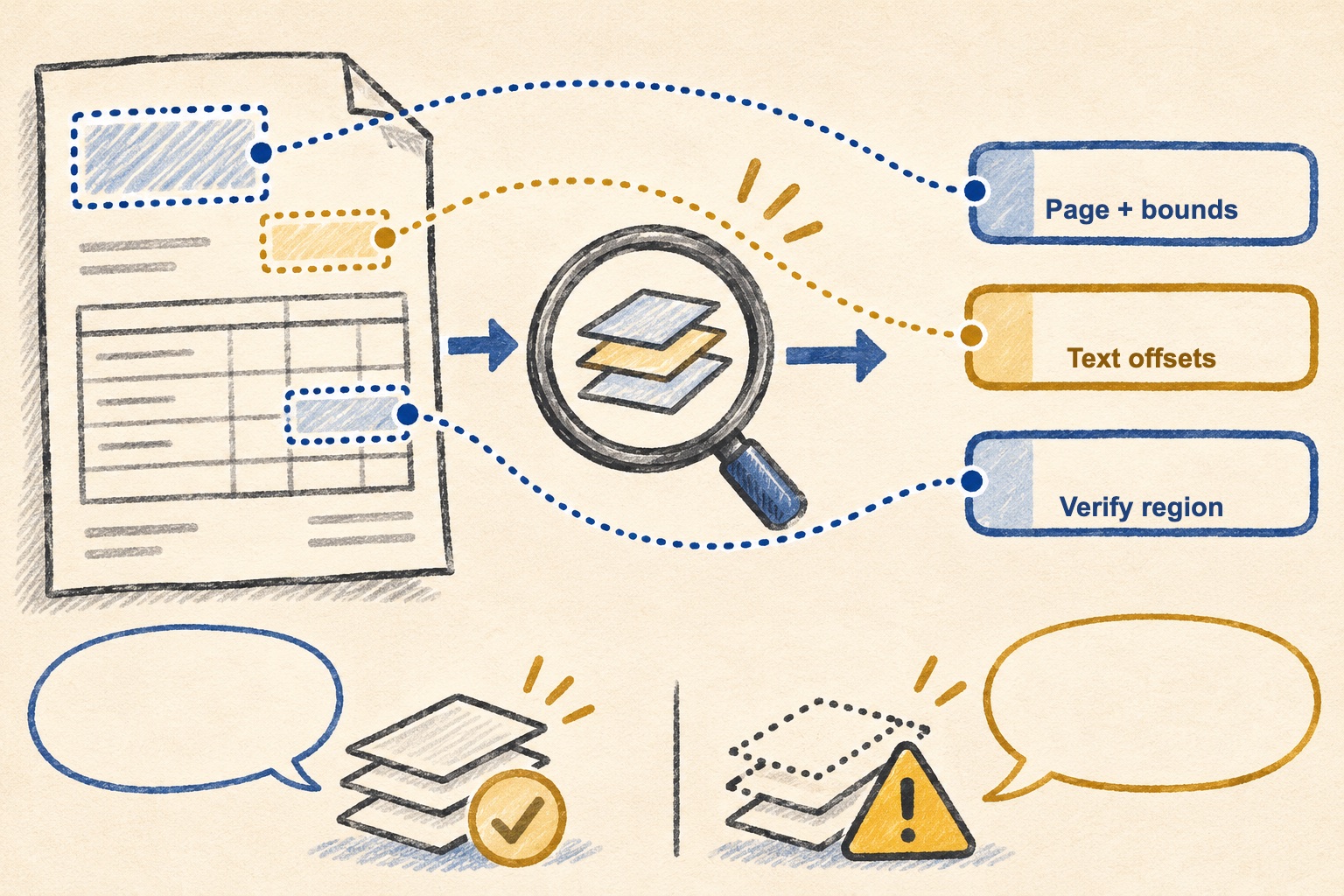
AI_EXTRACT turns a natural-language request into structured values from text or documents. When citation => TRUE is enabled, the response includes a citations object alongside the extracted response. Snowflake says the feature is a preview, requires cross-region inference to be enabled for the account, and adds no separate citation-call charge beyond the standard AI_EXTRACT call.
From a field to a place on the page
Imagine a contract review pipeline asking for the renewal notice period. A value such as “60 days” is not enough for a reviewer. They need to jump to the clause, see whether the clause is conditional, and decide whether “60 days” means calendar days or business days. A page number and bounding box can take the reviewer to the source region; an offset can do the same for a text input. This closes an important usability gap between extraction and verification.
The citation also gives an application a better interface pattern. Show the extracted field beside a “view source” affordance, preserve the original document, and highlight the cited region when available. A reviewer can accept, correct or escalate the value without searching manually. For high-impact fields, keep the reviewer decision and the source document version together so later audits do not depend on a temporary viewer state.
Location is not entailment
A citation indicates where the system says supporting material came from. It does not guarantee that the cited span entails the value, that the model interpreted a table correctly, or that the document is current and authoritative. A bounding box could point to a neighboring row; a sentence could contain an exception later in the paragraph. Citation review is still a reasoning task, especially when the question asks for a conclusion rather than a literal value.
That suggests a layered pipeline: validate the document identity and version first; extract candidate fields with citations; apply deterministic checks to format, range and cross-field relationships; then route consequential or ambiguous values to a person. Log both the source location and the final decision. A citation can make this process faster and more auditable, but it should not silently turn a probabilistic extraction into an approved fact.
What teams should test in preview
Use examples that include multi-column tables, footnotes, repeated labels, scanned pages and explicit exceptions. Check that each returned field maps to the right page and region, and that the location remains useful after the document is rendered at different zoom levels. Measure correction rates on your own document mix; the announcement offers no accuracy benchmark, so vendor-wide performance claims would be premature.
The change is valuable because it makes review navigable. It gives a human a shorter path from “the system returned this value” to “here is the evidence it used.” The responsible conclusion is correspondingly modest: citations improve traceability; verification still decides whether the field should be trusted.
Conceptual AI-generated illustration; the document and marked regions are illustrative, not a real Snowflake result.
Frequently asked questions
What do AI_EXTRACT citations contain?
For document inputs, Snowflake documents page numbers and bounding boxes; for text inputs, citations identify start and end offsets for supporting passages.
Do AI_EXTRACT citations guarantee an extracted value is correct?
No. They identify source locations that support a value, making human or downstream verification easier; readers still need to check whether the cited region actually supports the interpretation.
Sources & further reading
Keep reading
Google Agent Registry Adds MCP Policy Hints, Not an Access Boundary
Google Cloud's Agent Registry adds preview IAP and human-review metadata for MCP tools. Learn what these hints clarify and what still must enforce access.
GPT-Live Standby Pauses Inference Without Closing a WebRTC Session
OpenAI’s standby mode pauses inference in silence and resumes on speech, trading lower idle rates for wake-up delay and an open microphone.
Cloudflare's Clairic Targets Document Extraction, Not Chat
Cloudflare's updated Clairic and compact 9B Clairic-flash extract typed fields from text, images and PDFs, with open weights now available.
/* Comments */
Comments are offline right now — we reconnect automatically, nothing is lost.