topic: ai-technology
author: Crashtech Editorial
date: Oct 7, 2026 · read: 2 min
updated: October 8, 2026
---
Test-Time Compute: What Extra Reasoning, Search and Verification Can Buy
Inference-time budgets can improve selected reasoning tasks. Search and process rewards are useful methods, not a universal architecture or guarantee.
On this page
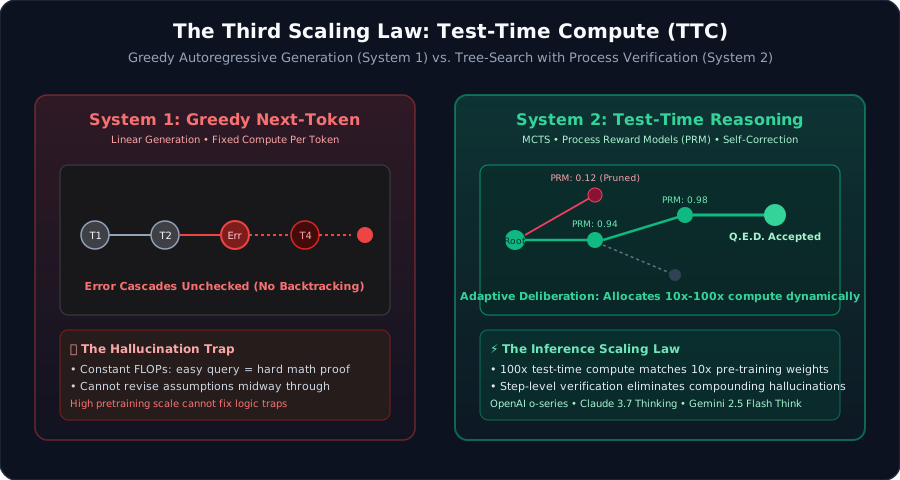
Conceptual architecture; arrows show relationships, not measured latency, energy or safety guarantees.
Training scale and inference budgets coexist
Pretraining changes the model before a request arrives. Inference-time allocation changes how much work the deployed system spends on that request. These are complementary choices, not proof that pretraining has stopped improving or that all useful human text has been exhausted.
Snell and colleagues study adaptive test-time computation and show that allocating the budget according to problem difficulty can matter. Their results concern evaluated models and tasks, not a universal replacement rate between model parameters and reasoning tokens. [1]
Several strategies can spend the budget
Best-of-N generates candidates and selects among them. Revision gives a model a chance to inspect an earlier attempt. Explicit tree search explores alternative intermediate states. Each adds work differently and needs an evaluation of its failure modes.
Process reward models evaluate intermediate steps, while outcome-based supervision focuses on final results. The Step by Step study reports benefits from process supervision for its mathematical reasoning setup. A learned score is still a prediction and can be wrong. [2]
A verifier should not automatically be described as returning a calibrated probability that every step is correct.
Published behavior is not a secret architecture diagram
OpenAI’s original o1 announcement reported gains from reinforcement learning and spending more time thinking. That does not establish that o1 runs Monte Carlo tree search or uses the exact process-reward pipeline shown in a conceptual illustration. [3]
“System 1” and “System 2” are useful analogies for fast and more deliberate behavior. They are not literal proofs that one language model lacks the ability to revise a premise while another reproduces human cognition.
Allocate work where it improves outcomes
A transactional lookup may benefit more from a reliable database query than from a long generated explanation. A difficult coding or mathematics task may justify candidate generation and external checks.
Measure success rate, latency, output length and cost together. Use held-out tasks to avoid selecting a budget that merely fits the examples used during development. Set a stopping condition for repeated failed attempts.
There is no universal table of per-million-query prices or benchmark percentages for “System 2.” Report the actual model, sampling policy, test set and computation budget. The useful question is whether the additional work improves the application enough to justify its cost.
Frequently asked questions
Is test-time compute a universally defined third scaling law?
The phrase is shorthand used in discussions of AI scaling. There is no mandatory three-part taxonomy or single equation that makes pretraining, post-training and inference interchangeable.
Do reasoning models all use Monte Carlo tree search?
No. Inference-time strategies include longer generated reasoning, repeated samples, revision, selection and explicit search. A model’s published capabilities do not establish its undisclosed internal algorithm.
/* Comments */
Comments are offline right now — we reconnect automatically, nothing is lost.