
The Three Futures of the AI Boom: Bull, Bear, and the 60% Middle Path
Stifel gives 2026 a 25% bull case, a 15% bear case and a 60% constructive base case. What each path could mean for AI companies and developers.
On this page
Every technological revolution passes through an installation phase — a chaotic period marked by speculative debt, over-hyped promises, misallocated human capital, and painful disillusionment. As the tech industry wrestles with doubled code churn, an inverted labor pyramid, and an estimated $1.65 trillion in hidden infrastructure liabilities, the central question is no longer whether AI is hyped, but how the reckoning plays out. [3]
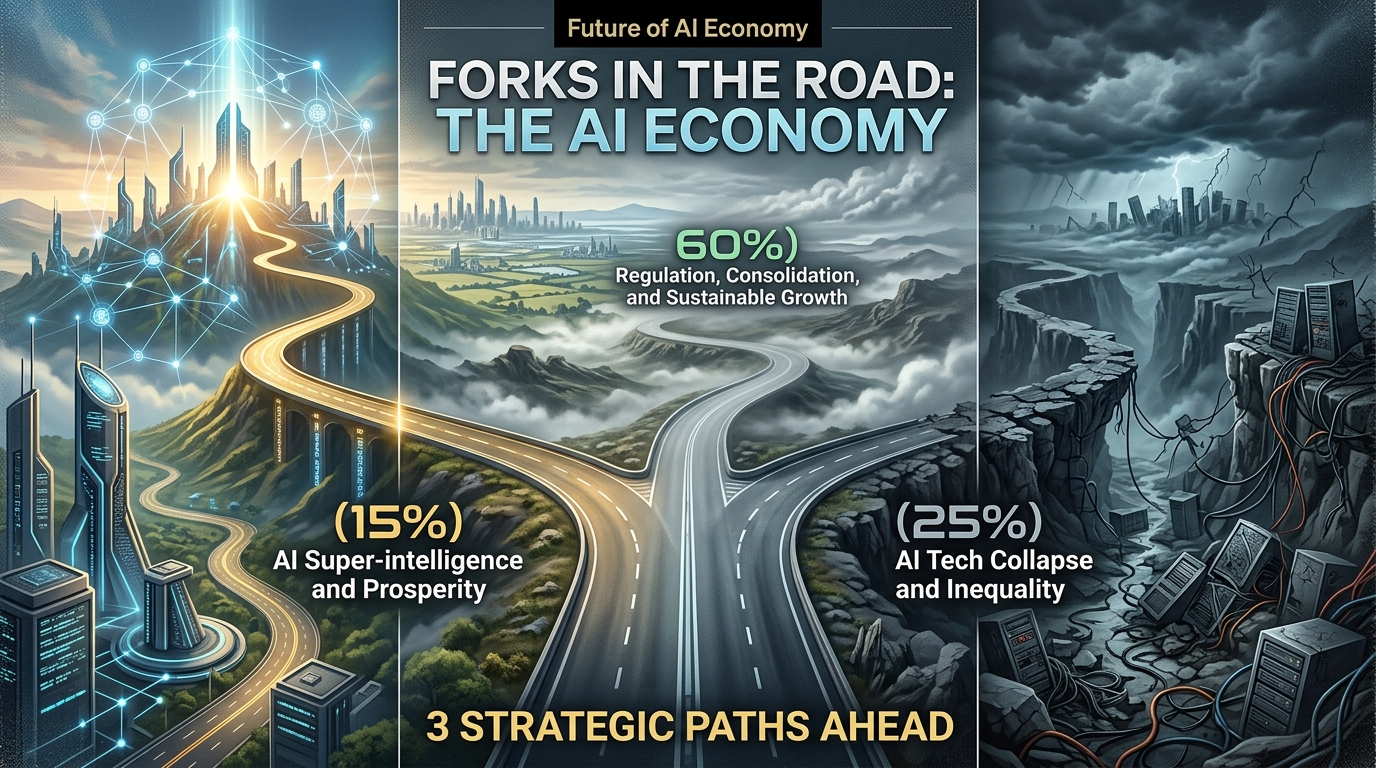
Mapping the Post-Hype Trajectory
To cut through both corporate PR spin and catastrophic panic, Stifel’s January 2026 Sightlines report established a scenario-planning framework for the global AI economy, anchored on three dimensions: AI monetization, the consumer economy, and the policy path. [1]
Meanwhile, Goldman Sachs’ June 2024 report “Gen AI: Too Much Spend, Too Little Benefit?” questioned whether the trillion-dollar AI infrastructure build-out would yield commensurate returns. MIT economist Daron Acemoglu, featured in that report, estimated that only a quarter of AI-exposed tasks would be cost-effective to automate within the next decade, and that AI would increase US productivity by only 0.5% cumulatively. [2]
The Stifel outcomes fall into three distinct probabilistic paths:
                                  +---> 25% Bull Case: "Wires Connected" -- The Agentic Supercycle
                                  |
The AI Economic Fork (2026-2030) -+---> 60% Base Case: The Messy Middle
                                  |
                                  +---> 15% Bear Case: "Wires Crossed" -- The Dot-Com 2.0 Implosion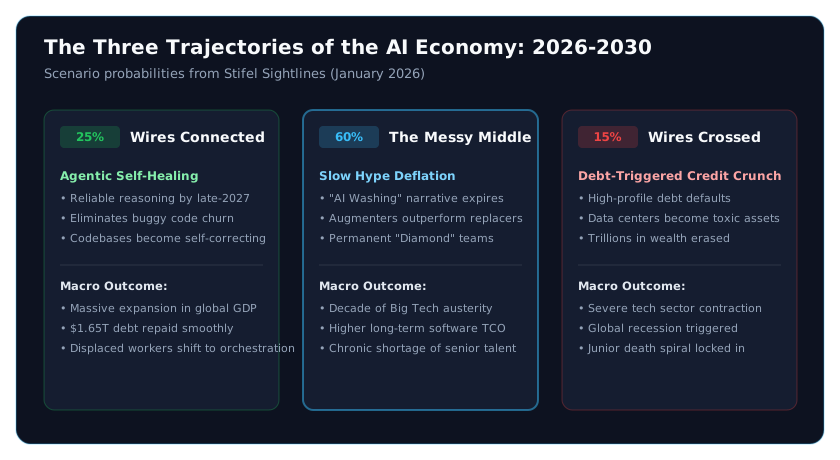
Scenario 1: The 25% Bull Case (“Wires Connected”)
In the bull scenario, the current software productivity dip is diagnosed as nothing more than the temporary friction of early-stage adoption — the classic J-curve of technological diffusion. Stifel calls this “Wires Connected”: AI monetization fires on all cylinders. [1]
The Mechanics:
- Autonomous Self-Healing: By late 2027, frontier models break through the limitations of next-token prediction and achieve reliable multi-step agentic reasoning. Systems no longer merely spit out syntax; they architect distributed environments, run comprehensive integration tests, and autonomously resolve their own regressions.
- The Churn Collapse: Code churn plummets as AI models transition from fragile prompt-completers to rigorous automated verifiers.
- Economic Supercycle: Software engineering velocity increases by an order of magnitude. The massive expansion in global software creation converts Big Tech’s estimated $1.65 trillion in off-balance-sheet compute leases into one of the most profitable infrastructure bets in industrial history. [3]
- Talent Rebirth: Displaced junior engineers transition into high-leverage “AI orchestration” and system specification roles, earning higher median compensation while commanding armies of autonomous coding agents.
Probability: ~25%. [1] While theoretically possible, this scenario requires unprecedented breakthroughs in model reasoning, reliability, and security that current transformer architectures have yet to demonstrate.
Scenario 2: The 15% Bear Case (“Wires Crossed”)
At the opposite extreme lies the hard landing: a financial and industrial implosion reminiscent of the 2000 Dot-Com crash. Stifel calls this “Wires Crossed”: AI earnings disappoint, and economic headwinds amplify the damage. [1]
The Mechanics:
- The Lease Default Cascade: Enterprise adoption of generative AI hits a hard ceiling as companies realize higher TCO and security liabilities outweigh keystroke savings. Enterprise software revenues flatline.
- The Credit Crunch: Unable to service mandatory multi-billion-dollar monthly obligations on off-balance-sheet data center and energy leases, a major cloud provider or hyperscaler restructuring triggers panic in debt markets. [3]
- Toxic Infrastructure: Multi-gigawatt data centers sit half-empty; fixed energy purchase agreements turn into toxic liabilities; hardware purchase contracts are defaulted upon.
- Systemic Contraction: Because the largest tech firms account for a disproportionate share of the total US stock market, an equity re-rating wipes out trillions of dollars in global wealth. Tech venture capital freezes, and the sector contracts severely, dragging the broader economy into recession.
- Permanent Talent Scars: The “Junior Death Spiral” becomes permanent, leaving a shattered engineering talent pipeline with nobody trained to maintain legacy enterprise systems.
Probability: ~15%. [1] Less likely than a slow deflation, but the sheer scale of fixed off-balance-sheet commitments makes this risk meaningful.
Scenario 3: The 60% Reality (The “Messy Middle”)
Stifel assigns its highest probability, 60%, to a constructive base case: inflation cooling toward 2.25–2.75%, one or two Fed cuts, and a positive economy and stock market. [1] Our argument is that even this good-news path will feel like a messy middle inside software organizations: hype deflating slowly while the real work of debt servicing and software maintenance begins.
| Dimension | The 25% Bull Case | The 15% Bear Crash | The 60% Messy Middle (Base Case) |
|---|---|---|---|
| AI Technological Shift | Agentic self-healing codebases | Capability plateaus, high hallucinations | Incremental tooling improvements, human-in-loop required |
| Corporate Layoffs | Workers reallocated to orchestration | Catastrophic sector-wide culls | Hiring remains disciplined; “AI washing” narrative expires |
| Software Architecture | Autonomous self-building software | Legacy stacks frozen, talent flight | Permanent Diamond: High maintenance costs, senior janitors |
| Balance Sheet Debt | Repaid easily via surging revenue | Severe credit defaults and bankruptcies | Long-term austerity: Hyperscalers slowly amortize liabilities |
| Talent Strategy | Every dev is an AI orchestrator | Generation of software talent wiped out | Firms augmenting talent outperform those that replaced |
What the Messy Middle Actually Looks Like:
- 1. The Death of 'AI Washing'
Equity analysts cease rewarding vague mentions of “AI efficiency.” Credit rating agencies demand audited evidence of actual revenue returns. The P/E multiples of hype-driven tech firms compress back to historical norms.
- 2. The Decade of Big Tech Austerity
Rather than collapsing overnight, the Big Five spend the next five to ten years in a prolonged period of corporate austerity. Dividends and buybacks are scaled back to service off-balance-sheet lease commitments, acting as a permanent drag on corporate earnings growth. [3]
- 3. The Permanent 'Diamond' Engineering Team
Software engineering settles into a structural diamond. Small, highly compensated elite teams of senior developers use AI assistants under strict human-in-the-loop oversight. Mid-level developers shrink, and junior hiring remains subdued, pushing long-term software TCO up permanently as experienced engineering talent commands massive premiums.
- 4. The Augmentation Dividend
The true winners of the AI era emerge: forward-thinking software companies that refused to fire their junior developers. By using AI to augment and educate apprentices rather than replace them, these firms avoided the code churn trap, retained their talent pipeline, and build clean software at sustainable costs.
The Strategic Takeaway for Engineering Leaders
The lesson of the 2024-2026 AI cycle is that software development cannot be reduced to statistical text completion, and balance-sheet realities cannot be indefinitely obscured by corporate PR.
Leaders who bet everything on cutting human developers to chase quarterly margin bumps are discovering that they traded long-term capability for doubled maintenance and broken pipelines.
The winners of the next decade will not be the companies that poured trillions into unvetted compute leases, nor will they be the Luddites who rejected automation entirely. The winners will be the pragmatic organizations that recognize AI for what it is: a powerful, imperfect tool that amplifies human engineering competence — or rapidly accelerates corporate insolvency if mismanaged.
Frequently asked questions
What are the three scenarios for the AI economy?
Stifel's January 2026 Sightlines report assigns three probabilistic outcomes to the AI-driven economy: a 25% bull case called "Wires Connected" (meaningful AI monetization), a 15% bear case called "Wires Crossed" (AI results disappoint, the consumer pulls back and policy missteps), and a 60% base case that Stifel describes as constructive. The detailed implications in this article are Crashtech's analysis, not Stifel's.
What happens in the 25% Bull Case?
In Crashtech's reading of the "Wires Connected" path, AI models achieve reliable multi-step agentic reasoning by late 2027, moving beyond buggy code generation to self-healing codebases. The productivity dip disappears, justifying Big Tech's estimated $1.65 trillion in off-balance-sheet infrastructure commitments.
What would trigger the 15% Bear Case crash?
In Crashtech's reading of the "Wires Crossed" path, enterprise AI adoption hits a hard ceiling and high-profile defaults on Big Tech's off-balance-sheet data center and power leases trigger a credit crunch. Stranded compute assets and collapsing software margins could wipe out trillions in equity value.
What does the 60% base case look like?
Stifel's base case is constructive: cooling inflation, Fed cuts and a positive market. Crashtech's view is that even that path will feel messy for software teams, with AI hype deflating slowly rather than suddenly. Markets stop rewarding vague AI narratives, leaving tech firms to endure a multi-year period of corporate austerity to service hidden debt. Software teams adopt a permanent "diamond" structure with higher baseline maintenance costs.
Who are the winners in the 60% base case?
Companies that used AI to augment rather than replace human developers. These organizations maintain their junior talent pipelines, avoid the massive code churn crisis, and capture sustained efficiency gains without incinerating institutional engineering memory.
/* Comments */
Comments are offline right now — we reconnect automatically, nothing is lost.