The AI Chip Rally Just Lost $1.3 Trillion in a Week
Semiconductor stocks erased roughly $1.3 trillion in July 2026 as Intel fell 21% and a Meta cloud-capacity report shook AI infrastructure bulls.
On this page
For the better part of a year, semiconductor stocks did nothing but climb, riding a hyperscaler spending spree that made chip stocks the closest thing Wall Street had to a sure bet. Then, in the space of a week, the market asked an inconvenient question: what happens if the AI buildout doesn’t need infinitely more chips? The answer wiped out $1.3 trillion in value and put a roughly 21% dent in Intel — and it started, of all places, with a story about Meta renting out spare cloud capacity.
What actually happened to chip stocks this week?
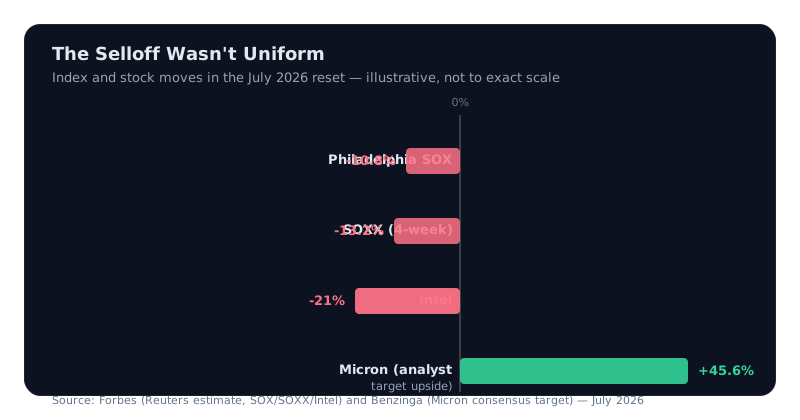
Investors erased roughly $1.3 trillion in semiconductor market value in a matter of days. Per Forbes, citing a Reuters estimate, “roughly $1.3 trillion in semiconductor market value has been wiped out, with Intel, Micron, AMD and Samsung all under pressure.” The damage showed up differently depending on which index you tracked: the Philadelphia Semiconductor Index (SOX) fell 10.8%, the VanEck Semiconductor ETF dropped 13% over ten sessions, and the iShares Semiconductor ETF (SOXX) fell 8% in a single week. Benzinga’s numbers tell a similar story from a wider lens — SOXX was down 13.2% over four weeks, its sharpest stretch since April 2025, and about 15% off its late-June peak.
Intel took the worst of it. Forbes’ own headline puts the figure at 21%; the article body describes shares down “more than 20 percent.” That’s a brutal reversal for a stock that had been one of 2026’s best performers — Benzinga has Intel up 349% year-to-date before the slide, a gain built almost entirely on AI-adjacent optimism.
The proximate trigger wasn’t a bad earnings report or a demand miss — it was a Bloomberg News story. Forbes reported that “Meta’s decision to rent out spare AI cloud services capacity… could clip AI capital-expenditure.” In a market pricing semiconductor stocks for years of uncompromising hyperscaler buying, a single hyperscaler admitting it has spare capacity was enough to move $1.3 trillion.
Why did investors suddenly get spooked?
Because the sector’s valuations had stopped pricing in whether AI capex keeps growing and started pricing in how much more it needs to grow. Hyperscalers had already ramped AI capital expenditure 67% to $650 billion, per Forbes — a number so large that any hint of a plateau reads as a demand shock. Meta’s own stock was in the middle of rallying on that same AI-cloud pivot; signaling it also has spare AI cloud capacity to rent out is exactly the kind of hint that cuts the other way for suppliers — it suggests the buildout may be outrunning what hyperscalers can actually put to work today.
Benzinga frames the same nervousness through valuation math. SOXX’s forward P/E hit 24.7x, roughly level with the Nasdaq 100’s 24.0x — meaning semiconductor stocks had stopped trading at a premium to the broader market for the first time since a peak above 32x in late June. BofA strategist Michael Hartnett’s Bubble Risk Indicator, meanwhile, hit 0.91, “well above the Nasdaq 100’s 0.69,” according to Forbes — a reading the bears could point to, even as valuations elsewhere had arguably gotten more stretched.
Are the fundamentals actually broken, or is this a valuation reset?
The underlying numbers look far healthier than the price action suggests, which is exactly what makes this read as a sentiment repricing rather than an earnings problem. Nvidia’s forward P/E of 21.7 is “attractive compared to the company’s five-year average of 72,” per Forbes — not the profile of a stock priced for collapse. Samsung posted a Q2 2026 operating profit of $58.4 billion, an 1,810% surge, and Forbes notes high-bandwidth memory is sold out through most of 2027. That’s not a demand air pocket; that’s a supply chain still straining to keep up.
The named research houses land on opposite instincts about what comes next. Morgan Stanley called the drop a “mid-cycle reset rather than a top.” Wedbush’s Dan Ives went further, framing it as barely underway: “This is 3rd inning, 1 out in a 9-inning game.” FBB Capital’s Mike Bailey summed up the tension driving the selloff more bluntly: “Expectations are up, and fundamentals are struggling to meet these sky-high demands.” Forbes also notes that “a bearish analyst compared valuations now to the June 2000 market, which presaged the bursting of the dot-com bubble” — the one dot-com reference in the coverage, offered as a minority view rather than a consensus call.
Up 654% over the past year to $904.28 by July 14, per Benzinga — yet its forward P/E of 6.8x sits well below its 16.8x historical average. Consensus rating stayed at Buy with zero analyst downgrades since June 25, and the consensus price target of $1,316.79 implies 45.6% further upside.
Intel’s stock dropped roughly 21% in the selloff, per Forbes, after a 349% year-to-date run (Benzinga). Forbes notes Intel was already trading about 8% above its own analyst price target going into the drop — the opposite cushion Micron has.
Is this a repeat of the dot-com bust?
Not according to the sources here — it’s a fringe comparison, not a consensus one. Only a single “bearish analyst,” per Forbes, drew the June 2000 parallel. Every other voice quoted — Morgan Stanley, Dan Ives, Mike Bailey — described a valuation reset or an expectations gap, not a bursting bubble. The clearer evidence against a dot-com-style collapse is the underlying business performance: Samsung’s chip division just posted its profit surge, HBM memory is sold out into 2027, and Nvidia’s forward earnings multiple has compressed toward more normal territory rather than expanded into bubble math.
| Metric | Reading | Source |
|---|---|---|
| Semiconductor value erased | ~$1.3 trillion | Forbes (Reuters estimate) |
| Philadelphia Semiconductor Index | -10.8% | Forbes |
| SOXX, 4-week move | -13.2% (sharpest since April 2025) | Benzinga |
| Intel | -21% (Forbes headline figure) | Forbes |
| Hyperscaler AI capex | +67% to $650B | Forbes |
| Nvidia forward P/E | 21.7 vs. 5-yr avg of 72 | Forbes |
| BofA Bubble Risk Indicator | 0.91 (Nasdaq 100: 0.69) | Forbes |
Do
- Separate the demand story (hyperscaler capex, HBM sold out into 2027) from the sentiment story (a single Bloomberg report on Meta)
- Track forward P/E and PEG ratios, not just year-to-date gains — Benzinga notes SOXX’s PEG hit 1.26x, its lowest since 2016
- Watch the next real data points: TSMC reports July 16, Intel reports July 23
Don't
- Don’t treat one bearish analyst’s dot-com comparison as market consensus — it wasn’t
- Don’t assume every chip name moved together: Micron kept a Buy consensus through the drop while Intel was already trading above its price target
- Don’t confuse a 10-20% pullback after a year-long rally with a fundamentals-driven collapse
What does this mean for developers and AI-native teams building on this infrastructure?
Nothing about GPU or memory availability changed this week; this was a repricing of chip-stock expectations, not a supply correction. High-bandwidth memory remains sold out through most of 2027 per Forbes, and Samsung’s chip division just posted an 1,810% profit surge — both signs the physical buildout teams depend on for inference and training capacity isn’t slowing down. What moved was how much future growth investors were willing to pay for today, triggered by one hyperscaler’s admission that it has AI cloud capacity to spare rather than by any team-facing shortage or price hike.
That distinction matters for anyone budgeting cloud AI spend for the next few quarters: a stock-market correction in the suppliers doesn’t automatically translate into cheaper GPU-hours, and it doesn’t guarantee the opposite either. The next real signal comes from TSMC’s July 16 earnings and Intel’s July 23 report — actual production and demand numbers, not one Bloomberg story about a hyperscaler’s spare capacity.
Frequently asked questions
How much semiconductor market value was wiped out in the July 2026 selloff?
Roughly $1.3 trillion in semiconductor market value was erased in early July 2026, according to a Reuters estimate cited by Forbes. The Philadelphia Semiconductor Index fell 10.8%, the VanEck Semiconductor Index dropped 13% over ten sessions, and Intel shares fell more than 20% as AI infrastructure spending came into question.
Why did Intel stock fall so sharply during the selloff?
Intel shares dropped roughly 21%, per Forbes' own headline figure, as the stock got caught in a broader semiconductor reset alongside Micron, AMD and Samsung. Investors grew nervous that AI capital spending — which had already jumped 67% to $650 billion among hyperscalers — might not keep expanding at the pace the market had priced in.
What role did Meta play in triggering the selloff?
A Bloomberg News report said Meta plans to rent out spare AI cloud computing capacity — a move Forbes reported could clip AI capital expenditure. That raised doubts about whether hyperscalers actually need all the chip capacity they have been buying, undercutting the demand story that had powered the sector's yearlong rally.
Are analysts comparing this selloff to the dot-com bubble?
One bearish analyst did — Forbes reported the comparison was made to "the June 2000 market, which presaged the bursting of the dot-com bubble." That view wasn't consensus: Morgan Stanley called the drop a "mid-cycle reset rather than a top," and Wedbush's Dan Ives said the AI buildout is still in early innings.
Is Micron still rated a buy after the selloff?
Yes. Despite climbing 654% over the prior year to $904.28 by July 14, Micron kept a Buy consensus with zero analyst downgrades since June 25, per Benzinga. Its forward P/E of 6.8x sat well below its 16.8x historical average, and its consensus price target implied roughly 45.6% further upside.
/* Comments */
Comments are offline right now — we reconnect automatically, nothing is lost.