
Meta Just Had Its Best Stock Week Since 2024 — Because It's Selling AI Compute Now
Meta shares surged 15% in a week, erasing 2026 losses, after new AI models and plans to resell excess compute through a Meta Compute cloud unit.
On this page
Three months ago, Meta’s AI capex guidance was the thing that spooked investors — the stock sank 7% the day the company raised 2026 spending guidance as high as $145 billion. This week, the same spending is the thing Wall Street is paying up for. Meta shipped two new AI models between Tuesday and Friday and kept leaning into a pitch it had already put in front of investors: resell the leftover computing power as a cloud service instead of just burning cash on it — and the market responded by handing the stock its best five days since early 2024. The pitch didn’t change. The framing did.
How big was Meta’s rally, in real numbers?
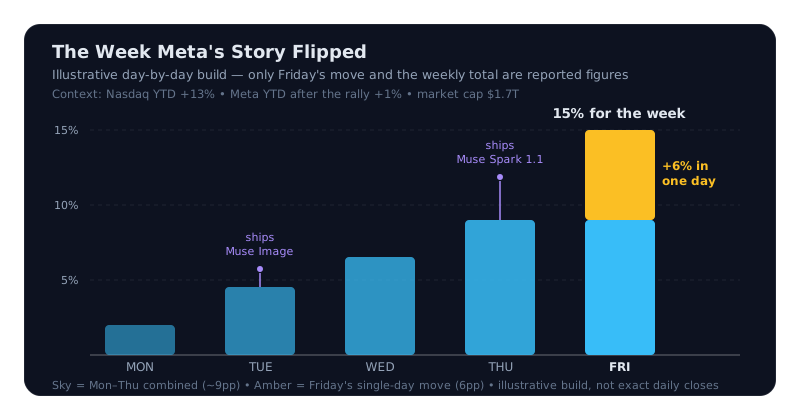
Meta stock rose about 15% for the week ending Friday, July 10, 2026, with 6 percentage points of that arriving in a single Friday session that carried shares to their highest level since April, according to CNBC. That week alone was enough to flip Meta’s year-to-date scoreboard: CNBC reported the stock was “up more than 1%” for 2026 after the rally, against a Nasdaq that was itself up roughly 13% year-to-date — so Meta went from a laggard with real losses to essentially caught up, not ahead. Meta’s market capitalization stood at $1.7 trillion as the rally played out Friday, CNBC reported.
The move didn’t come from an earnings beat — Meta’s next quarterly print hadn’t landed yet. It came from three announcements stacked inside one week:
| Day | What happened |
|---|---|
| Tue, Jul 7 | Meta released Muse Image, a new AI image-generation model aimed at creators and advertisers |
| Thu, Jul 9 | Meta shipped Muse Spark 1.1, an agentic and coding-focused update to the Spark model line it launched three months earlier |
| Fri, Jul 10 | Shares jumped 6% to their highest level since April, capping the week’s roughly 15% gain |
What is Meta Compute, and why did it flip the narrative?
Meta Compute is the company’s plan to sell excess AI computing capacity to outside customers, competing head-on with Amazon Web Services, Microsoft Azure and Google Cloud, according to the Motley Fool. That’s a structurally different pitch from “we’re spending a fortune on GPUs to power our own apps” — it reframes Meta’s infrastructure as a product with a customer base, not a cost center with no ceiling.
The timing matters. Meta’s capex jumped 84% year-over-year in 2025 to $72.2 billion, and 2026 guidance runs as high as $125–$145 billion, per the Motley Fool — spending that had been read for most of the year as the reason to worry about Meta, not buy it. Turning a fraction of that buildout into a resold service doesn’t erase the bill, but it gives investors a second way the money comes back, on top of Meta’s existing ad business, where revenue was already up 33% year-over-year in Q1 2026.
Meta isn’t inventing this model — it’s copying one that’s already working. The Motley Fool notes Alphabet reportedly pays SpaceX $920 million a month for AI compute capacity, a sign of just how supply-constrained the AI infrastructure market currently is. When a company that isn’t primarily in the cloud business can charge that much for spare capacity, “we overbuilt, let’s sell the overflow” stops sounding like a rationalization and starts sounding like a second business line — the same compute-scarcity dynamic sits underneath SpaceX’s own valuation story.
$145B in capex framed as a bet Meta couldn’t clearly monetize — margin risk with no obvious ceiling, and the reason the stock spent months underwater.
The same infrastructure reframed as sellable capacity via Meta Compute, positioned against AWS, Azure and Google Cloud — a potential revenue line, not just a cost.
Why did Wall Street suddenly like the math it was punishing months ago?
Because a Bank of America analyst told them the spending was cheaper than they’d modeled. BofA’s Justin Post wrote that “Meta may have engineered significant cost savings to get capacity cost per MW well below our and Street expectations,” according to CNBC — the kind of line that turns a feared cost overrun into an efficiency story. BNP Paribas senior analyst Nick Jomes struck a similar note, telling CNBC that Meta looks “well positioned to generate ample revenue to support its spending,” pointing to “monetization of its own AI initiatives, advertising share gains, incremental subscription revenue” and the optionality of a cloud offering — while BNP Paribas separately estimated Meta could raise its 2026 capex guidance again, to a range of $135–$155 billion.
Options traders piled in on the same thesis. Friday’s options volume ran at more than three times its 30-day average, and 78% of the $1.8 billion in options premium traded that day was tied to calls, CNBC reported — more than twice as many calls bought as puts, with 8 of the 10 most active contracts by volume also calls. The single most active post-Friday contract was a July 17, $700-strike call, a bet that needed roughly a 6% further advance just to break even. One trader took the other side, selling $29 million of both puts and calls at the $670 strike — a wager that Meta simply goes nowhere from here.
Behind the trading desks, the infrastructure roadmap kept moving too: Meta’s custom “Iris” AI chip begins manufacturing in September, feeding into a target of 14 gigawatts of compute capacity next year, per CNBC.
Is this a fundamentals story or a narrative reset?
It’s mostly the second, and the numbers say so. A single week — even a 15% one — moved Meta from real 2026 losses to barely positive, while the Nasdaq was still running about 13 percentage points ahead year-to-date. Nothing about Meta’s underlying spending changed between Monday and Friday; what changed was which story analysts and options traders decided to tell about the same $145 billion budget. That’s the pattern this publication has tracked before in Meta’s AI era — a company whose strategic pivots have outrun its execution as often as they’ve vindicated it. A cost-per-megawatt estimate from one analyst desk is a real, useful data point. It is not the same thing as Meta Compute having signed a single paying customer.
Do
- Track whether Meta Compute lands actual paying customers, not just the announcement — a cloud “business” with zero disclosed contracts is still a plan
- Watch the next capex print closely — BNP Paribas already expects Meta to guide even higher, to $135–$155 billion, which resets the bar this rally has to clear
- Compare Meta’s YTD number to the Nasdaq’s, not just to its own worst week — one strong week narrowed a gap, it didn’t close it
Don't
- Don’t treat a single analyst’s cost-per-megawatt estimate as confirmed financials — Justin Post’s note is a model, not an audited disclosure
- Don’t read heavy call-buying as certainty — 78% of premium in calls is a crowded bullish bet, and crowded bets can unwind as fast as they build
- Don’t assume Muse Image and Muse Spark 1.1 driving the rally means they’re driving revenue yet — the stock moved on the story, not on reported usage numbers
What should developers and enterprises watching this pivot expect next?
Watch September and the next earnings call, not this week’s chart. Meta’s Iris chip enters manufacturing in September, feeding the 14-gigawatt capacity target CNBC reported for next year — the first concrete checkpoint for whether “Meta Compute” becomes a real product with pricing and customers, or stays a line in investor calls. Meta has already been shipping fast on the model side, with Muse Image and Muse Spark 1.1 landing within 48 hours of each other; if Meta Compute follows that same cadence, the first real signal will be whether Meta announces actual API pricing or a named enterprise customer, not another capex number.
For now, the honest read is that Meta bought itself a much better story for the same underlying spending plan. Justin Post’s cost estimate, Nick Jomes’s monetization framing, and a call-heavy options market all point the same direction — but a 15% week built on analyst notes and options positioning is a repriced narrative, not yet a proven business. Meta Compute has to actually sell compute before this rally is anything more than Wall Street deciding to like a story it was skeptical of three months ago.
Frequently asked questions
How much did Meta's stock rise the week of July 10, 2026?
Meta shares climbed roughly 15% for the week ending July 10, 2026 — including a 6% single-day jump on Friday that pushed the stock to its highest level since April — marking Meta's best week since early 2024 and pushing its market capitalization to $1.7 trillion, according to CNBC.
What is Meta Compute?
Meta Compute is a planned cloud business through which Meta intends to sell its excess AI computing capacity to outside customers, directly competing with Amazon Web Services, Microsoft Azure and Google Cloud, according to the Motley Fool — turning Meta's infrastructure budget into a potential revenue line.
Why did Wall Street suddenly warm to Meta's massive AI spending?
Bank of America analyst Justin Post said Meta appeared to have engineered cost savings that pushed its AI capacity cost per megawatt 'well below' Street expectations, per CNBC — reframing years of feared overspending as infrastructure Meta can now resell rather than write off as pure overhead.
Did the rally erase Meta's stock losses for 2026?
Yes — CNBC reported the week's surge left Meta shares up more than 1% for 2026, reversing what had been a losing year for the stock, even as the Nasdaq itself was up roughly 13% year-to-date, meaning Meta was still trailing the broader market's gains.
What AI products did Meta launch during its rally week?
Meta shipped two AI products in quick succession: Muse Image, an image-generation model aimed at creators and advertisers, on Tuesday, followed Thursday by Muse Spark 1.1, an updated agentic and coding-focused model building on the Spark line Meta introduced three months earlier.
Sources & further reading
Keep reading

OpenAI's Rosalind Academic Plan Has a Narrow Lab-Shaped Door
The Rosalind Academic Plan offers up to 30 seats for eligible US university labs for up to a year, but excludes API access and requires trusted-access review.
The 'AI Washing' Debate: Is Big Tech Using AI to Disguise Mass Layoffs?
AI mentions on earnings calls surged 310% in early 2026. With AI now the top cited reason for US job cuts, the line between strategy and spin blurs.
The $1.65 Trillion Time Bomb: The Off-Balance-Sheet Debt Powering the AI Boom
Big Tech carries $1.65 trillion in hidden off-balance-sheet compute obligations, exceeding its $1.35 trillion in reported debt. What happens next?
/* Comments */
Comments are offline right now — we reconnect automatically, nothing is lost.