Apple Just Bet $30 Billion That Chips Should Be Made in America
Apple extended its Broadcom chip deal through 2031 in a pact worth $30B+, covering 15 billion US-made chips and a $1.5B Colorado plant.
On this page
Somewhere in a Broadcom regulatory filing dated July 6, 2026, a number appeared that Apple’s own press office wouldn’t confirm until two days later: over $30 billion, committed through 2031, for the unglamorous business of radio-frequency filters and custom silicon nobody outside a teardown report ever thinks about. No keynote, no stage, no Tim Cook holding up a chip. Just a filing, a follow-up press release, and one of the largest single line items in Apple’s domestic manufacturing story to date.
What exactly did Apple and Broadcom agree to?
A multiyear extension, worth more than $30 billion, that keeps Broadcom building custom silicon and RF components for Apple products through 2031. Per Apple’s own announcement, the deal covers custom silicon components and cutting-edge wireless connectivity technologies, and commits to producing more than 15 billion chips on US soil — chips that end up inside iPhones, other Apple hardware, and, per Bloomberg, Apple’s in-development AI infrastructure.
The centerpiece of the physical build-out is a $1.5 billion expansion and modernization of Broadcom’s existing Fort Collins, Colorado facility, which makes advanced RF components — including FBAR filters, the tiny devices that keep a phone’s radio signals from bleeding into each other — along with wireless connectivity technology. Apple says the expansion supports hundreds of American jobs. It’s a specific, physical, hire-people commitment, not a spending pledge that lives only on a balance sheet.
| Deal at a glance | Figure |
|---|---|
| Total deal value | $30B+ |
| Contract extension | Through 2031 |
| US-made chips pledged | 15B+ |
| Fort Collins facility investment | $1.5B |
| Jobs supported | Hundreds |
| Program | Apple American Manufacturing Program (AMP) |
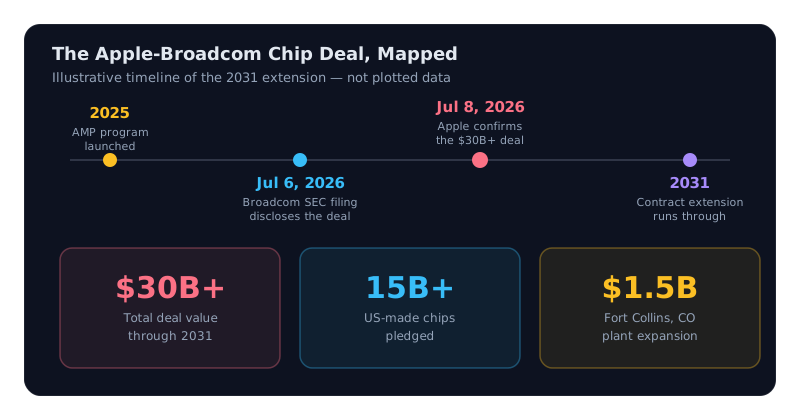
Bloomberg’s report, dated July 6, traces back to a Broadcom SEC filing — the disclosure a publicly traded supplier is obligated to make when a customer relationship this material changes. Apple’s own newsroom post and the wider CNBC coverage followed on July 8. Broadcom’s shareholders technically knew the shape of this deal before Apple’s customers did — a small reminder that even Apple’s most tightly stage-managed announcements sometimes get scooped by securities law.
Why Fort Collins, and why RF chips specifically?
Because RF is the part of the smartphone stack Apple still can’t build itself. Fort Collins has been a Broadcom (by way of Hewlett-Packard and Avago) manufacturing site for RF filters for years; this deal doesn’t create a new facility, it modernizes and scales an existing one that already knows how to make FBAR filters at volume. That’s a meaningfully different — and more credible — kind of “reshoring” than announcing a greenfield fab: it’s capital going into a plant that already ships product, not a groundbreaking ceremony for something that might exist in five years.
How does this fit into Apple’s $600 billion pledge?
As the single largest piece disclosed so far. The Broadcom deal sits inside Apple’s American Manufacturing Program (AMP), which the company launched in 2025 alongside partners including Corning, GlobalFoundries, and Texas Instruments — itself one strand of Apple’s broader commitment to invest $600 billion in the US economy over four years. Apple’s own framing calls this its largest single AMP commitment to date, which says as much about how the other AMP deals are sized as it does about Broadcom’s importance to Apple’s supply chain.
That framing matters for how to read the number. $30 billion isn’t new money stacked on top of the $600 billion pledge — it’s a slice of it, made concrete with a named supplier, a named city, and a named contract end date. Most of Apple’s US-manufacturing rhetoric since the pledge launched has been aspirational; this is one of the few times it’s arrived with a dollar figure, a facility address, and a filing to back it up.
Why does Broadcom need Apple this badly?
Because Apple is worth roughly 20% of Broadcom’s annual revenue — a concentration that makes a 2031 lock-in valuable to both sides, but especially to Broadcom. Losing Apple, or even seeing Apple meaningfully shrink its order volume, would be a revenue event Broadcom’s other custom-chip relationships couldn’t fully absorb on their own.
Those other relationships are also part of the context. Broadcom has built itself into one of the AI infrastructure trade’s central suppliers, working with a handful of the largest AI compute buyers on custom accelerator silicon — a customer list that, per Bloomberg’s reporting, includes Google, Meta, Anthropic, and OpenAI alongside Apple. The Apple extension folds in a new piece of that same story: a custom AI server chip codenamed Baltra, reportedly targeted for rollout as early as next year to support Apple Intelligence’s cloud compute needs. Locking Apple in through 2031 isn’t just about iPhone RF chips anymore — it’s about keeping Apple’s AI data-center silicon inside the same supplier relationship, the same way OpenAI’s own infrastructure spending has become inseparable from its financial story.
Apple’s own cellular modem debuted in the iPhone 16E, cutting reliance on Qualcomm for one specific chip category. It’s real progress on silicon independence — but it doesn’t touch RF front-end, Wi-Fi, Bluetooth, or the ASICs Broadcom still supplies.
Apple accounts for roughly a fifth of Broadcom’s annual revenue. The new deal locks in RF, wireless, and ASIC supply for five more years — plus a foothold in Apple’s AI server silicon via the Baltra chip program.
Does this mean Apple is dropping its in-house chip ambitions?
No — it means the parts Apple hasn’t in-sourced are the parts it just paid $30 billion to keep outsourcing, on a five-year contract. Apple has spent years publicly narrating a silicon independence story: the M-series Macs, the in-house cellular modem, the steady drumbeat of custom chips replacing merchant silicon across its product lines. The Broadcom extension is the quiet counter-chapter to that story — RF filters, wireless connectivity, and now AI server silicon are apparently hard enough, or Broadcom’s execution good enough, that Apple chose a longer contract over a build-it-yourself roadmap.
Do
- Read this as a supply-chain lock-in story, not a leading-edge fab story — Fort Collins makes RF filters and wireless chips, not the sub-3nm logic dies TSMC still owns
- Track Baltra as the more consequential long-term signal — it puts Broadcom inside Apple’s AI infrastructure buildout, not just its phone bill of materials
- Treat the $30B as part of Apple’s existing $600B US pledge, not incremental spend on top of it
Don't
- Assume this reduces Apple’s dependence on Asian manufacturing broadly — this deal is specifically about RF/ASIC supply, not chip fabrication at the leading edge
- Confuse Apple’s own C1 modem progress with independence from Broadcom — the two chip categories barely overlap
- Treat “hundreds of jobs” as a jobs-program headline number — it’s a real but modest figure next to the $30B and $1.5B totals
What does this mean for developers and the AI industry?
It means the AI infrastructure money trail keeps running through the same handful of chip suppliers, regardless of which company’s logo is on the front of the deal. Baltra ties Broadcom into Apple’s AI server buildout the same way Broadcom already builds custom accelerators for Google, Meta, Anthropic, and OpenAI — which means the practical compute capacity behind Apple Intelligence, and behind a good chunk of the rest of the AI industry, increasingly funnels through one company’s design and manufacturing pipeline. For developers watching AI infrastructure capacity as a leading indicator of what ships next, Broadcom’s order book — not just Nvidia’s — is now a number worth tracking.
For the “chips made in America” narrative specifically, this is the most concrete data point Apple has produced under its manufacturing pledge: a real dollar figure, a real facility, a real contract end date. Whether that’s a template Apple repeats with its other AMP partners, or a one-off sized to Broadcom’s outsized importance to the iPhone bill of materials, is the question the next AMP announcement will actually answer.
Frequently asked questions
How much is the Apple-Broadcom chip deal worth?
Apple's expanded partnership with Broadcom is worth more than $30 billion, disclosed via a Broadcom filing on July 6, 2026 and detailed by Apple two days later. It extends their custom-silicon relationship through 2031, covering ASICs, RF, and wireless chips, plus a pledge of over 15 billion US-made chips.
What is Broadcom building at its Fort Collins, Colorado facility?
Broadcom is spending $1.5 billion to expand and modernize its Fort Collins, Colorado plant, which makes advanced radio-frequency components — including FBAR filters — and wireless connectivity technology for Apple devices. The expansion supports hundreds of American jobs and is Apple's largest single American Manufacturing Program commitment yet.
Is this part of Apple's broader US manufacturing pledge?
Yes. The Broadcom deal sits inside Apple's American Manufacturing Program, launched in 2025 alongside partners like Corning, GlobalFoundries, and Texas Instruments, which itself sits under Apple's wider pledge to invest $600 billion in the US economy over four years. It's the single largest AMP commitment disclosed so far.
Why does Apple still depend on Broadcom for chips?
Broadcom supplies custom RF, Wi-Fi, Bluetooth, and ASIC components that Apple's own silicon team hasn't replicated in-house. Apple's C1 modem, which debuted in the iPhone 16E, cuts reliance on Qualcomm for cellular modems — but the 2031 Broadcom extension shows Apple is nowhere near building its own RF and wireless chips.
What is the 'Baltra' chip mentioned alongside the Apple-Broadcom deal?
Baltra is Broadcom's internal codename for a custom AI server chip it's developing for Apple, reportedly targeted for rollout as early as next year to support Apple Intelligence's cloud compute needs. It extends the Apple-Broadcom partnership from phones and wearables into AI data-center silicon.
/* Comments */
Comments are offline right now — we reconnect automatically, nothing is lost.