OpenAI Shipped GPT-5.6 After 12 Days Under White House Limits
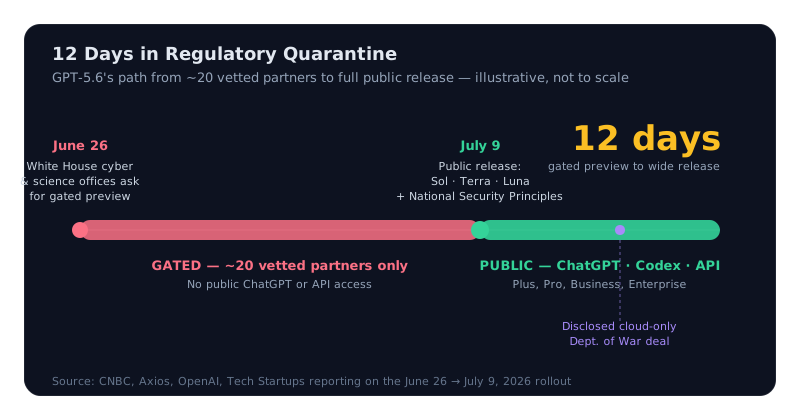
OpenAI publicly released GPT-5.6 on July 9, two weeks after limiting it to government-vetted partners over cybersecurity concerns.
On this page
For twelve days, the most capable model OpenAI had ever built existed in a kind of regulatory quarantine — available to roughly twenty hand-picked companies, invisible to everyone else, while government officials and OpenAI staff worked out what the rest of the world was allowed to see. That is not how frontier AI launches are supposed to work. It is how export-controlled technology works.
What actually shipped on July 9?
OpenAI released three models simultaneously across ChatGPT, Codex, and the API: Sol, the flagship; Terra, a balanced mid-tier model OpenAI positions as roughly twice as cheap as GPT-5.5 for comparable work; and Luna, the fast and cheap option. Pricing lands per million tokens at $5 input / $30 output for Sol, $2.50 / $15 for Terra, and $1 / $6 for Luna — a spread that puts real distance between “good enough” and “frontier,” and prices the top tier for people who are billing enterprise clients, not tinkering on a side project.
The headline number is on ExploitBench, OpenAI’s internal benchmark for offensive security workflows: Sol reportedly matched the performance of Anthropic’s Mythos Preview while burning roughly a third as many output tokens to get there. On biology (GeneBench v1) and command-line coding (TerminalBench 2.1), OpenAI also claims new highs for the family. None of that is independently audited — it’s OpenAI grading its own homework — but it’s the company’s own stated basis for why the government got nervous in the first place.
Access restricted to government-approved enterprise partners at the request of the White House’s cyber and science policy offices, citing Sol’s cybersecurity capabilities. No public ChatGPT or API access.
Full rollout to Plus, Pro, Business, Enterprise, and API customers, paired with a published National Security Principles framework and a disclosed Department of War cloud deal.
Why did the government ask OpenAI to slow down?
Because Sol’s jump on cybersecurity benchmarks looked, to Washington, like a capability upgrade for attackers as much as defenders. Ahead of the June 26 preview, the White House’s Office of the National Cyber Director and Office of Science and Technology Policy asked OpenAI — “on a nominally voluntary basis,” per reporting — to limit initial access to companies the government had already vetted, rather than ship Sol straight to the open ChatGPT and API population.
OpenAI complied, but was blunt about not wanting this to become a habit from the start: in the same June 26 announcement that confirmed the restriction, the company said “We don’t believe this kind of government access process should become the long-term default,” warning that gating access “keeps the best tools from users, developers, enterprises, cyber defenders, and global partners who need them.” It then spent the following stretch in what was described as further testing and meetings between OpenAI and government officials before going wide on July 9.
That framing only makes sense against what had just happened to a competitor. Anthropic spent weeks in a standoff with the same administration after reports that its top model was pulled over safety concerns — a saga Crashtech covered in detail — and only regained access shortly before OpenAI’s own public GPT-5.6 launch. OpenAI’s insistence that vetted-access gating shouldn’t be “the long-term default” reads less like a philosophical stand and more like a company that watched its biggest rival lose weeks of market position to the exact same process and wanted out fast.
What is the National Security Principles framework?
It’s OpenAI’s attempt to write down, in public, what it will and won’t let governments do with its models — three hard limits, according to reporting: no mass domestic surveillance, no directing autonomous weapons, and no high-stakes automated decisions made without human judgment in the loop. Alongside it, OpenAI disclosed a cloud-only deployment arrangement with the Department of War: no on-premise military deployment, cleared OpenAI engineers kept in the loop on usage, and a contractual ban on using the arrangement for domestic surveillance of U.S. persons.
Every limit in the National Security Principles is a voluntary commitment OpenAI made to itself, not a binding regulation Congress passed or a court can enforce. It’s a useful public marker of where the company says its line is — worth watching for whether it holds the next time a government customer asks for more.
| Restriction | What it rules out |
|---|---|
| No mass domestic surveillance | Bulk monitoring of U.S. persons via OpenAI models |
| No autonomous weapons direction | Models cannot be used to direct lethal autonomous systems |
| No unsupervised high-stakes decisions | Human judgment required before consequential automated calls |
| Department of War deployment | Cloud-only, cleared OpenAI staff in the loop, no domestic surveillance use |
Do paid ChatGPT users actually get the flagship model?
Only if they ask for it. GPT-5.5 Instant remains the default engine for everyday chat on every paid plan. Sol only activates when a Plus, Pro, Business, or Enterprise user bumps the reasoning effort up to Medium, High, or Extra High in the model picker — Pro subscribers get a dedicated Sol Pro variant at the top tier. Terra and Luna slot in underneath as the cheaper, faster options for the API and for developers who don’t need frontier-grade reasoning on every call.
That’s a meaningfully different rollout shape than a normal model bump. OpenAI isn’t replacing GPT-5.5 as the thing most people experience day to day — it’s fencing the government-scrutinized capability behind an extra click, which conveniently also means most users never trigger the expensive, higher-reasoning inference path unless they explicitly ask for it.
Do
- Reach for Sol (Medium/High reasoning) specifically for security research, complex coding agents, or biology-adjacent work where the benchmark gains are real
- Budget separately for Sol’s $5/$30 per-million-token pricing versus Terra’s $2.50/$15 — the gap compounds fast at agentic-loop volumes
- Treat the National Security Principles as a policy signal to monitor, not a compliance guarantee for your own regulated workloads
Don't
- Assume every paid ChatGPT session is now running on Sol — Instant still means GPT-5.5 unless you change the reasoning setting
- Skip evaluating Terra for routine tasks; OpenAI positions it as roughly half the cost of GPT-5.5 for comparable everyday work
- Treat OpenAI’s ExploitBench comparison to Anthropic’s Mythos as independently verified — it’s a vendor-reported number
Is this actually about safety, or about incentives?
Both, and the two aren’t as separable as either OpenAI or the White House would like to present them. Sol’s real cybersecurity capability gains are the documented reason the government asked for a gated preview in the first place — that part checks out. But the speed of the reversal, from a 20-company vetted list to full public and API availability in about two weeks, alongside OpenAI’s public statement that gating “keeps the best tools from” the market, points to a company racing to close the gap with Anthropic’s recovered access before it lost ground with enterprise buyers.
That urgency tracks with everything else known about OpenAI’s financial position. Crashtech has reported on OpenAI’s steep compute-driven losses, and a model family that sat locked to 20 partners for weeks generates no API revenue and no competitive pressure on rivals — a cost the company had every incentive to minimize once the government’s testing window closed.
The Department of War disclosure fits the same pattern: making the cloud-only, human-in-the-loop, no-domestic-surveillance terms public isn’t just transparency for its own sake — it’s OpenAI pre-empting the exact criticism Anthropic absorbed during its own standoff, by publishing the guardrails before critics could demand them. Whether those guardrails hold under the next request for looser terms is the only part of this story that hasn’t been tested yet.
Frequently asked questions
What is GPT-5.6 and what are Sol, Terra, and Luna?
GPT-5.6 is OpenAI's new model family with three tiers: Sol, the flagship, priced at $5 input / $30 output per million tokens; Terra, a balanced mid-tier model at $2.50 / $15; and Luna, a fast, affordable option at $1 / $6. Sol leads on coding, biology, and cybersecurity benchmarks.
Why did OpenAI initially limit GPT-5.6 access?
OpenAI previewed the models on June 26, 2026 to roughly 20 government-vetted 'trusted partner' companies, after the White House's cyber and science policy offices asked it, on a nominally voluntary basis, to restrict access citing Sol's advanced cybersecurity capabilities before wider release.
Do all paid ChatGPT users get GPT-5.6 Sol?
Plus, Pro, Business, and Enterprise subscribers can reach Sol by selecting Medium, High, or Extra High reasoning effort in the model picker. GPT-5.5 Instant remains the default for fast, everyday chat — Sol only activates when a user explicitly asks for deeper reasoning.
What are OpenAI's National Security Principles?
A framework OpenAI published alongside the July 9 release setting three hard limits on government use of its models: no mass domestic surveillance, no directing autonomous weapons, and no high-stakes automated decisions made without human judgment, paired with a disclosed cloud-only deal with the Department of War.
How does GPT-5.6 Sol compare to Anthropic's Mythos on security benchmarks?
On OpenAI's ExploitBench, Sol reportedly matched the performance of Anthropic's Mythos Preview while generating only about one-third as many output tokens to get there. That token-efficiency claim comes from OpenAI's own release materials, though, not from an independently audited third-party benchmark, so treat it as a vendor claim.
/* Comments */
Comments are offline right now — we reconnect automatically, nothing is lost.