Meta Let AI Remix Anyone's Instagram Photos — Then Killed It in 3 Days
Meta's Muse Image feature let anyone turn public Instagram photos into AI art by default. SAG-AFTRA and CAA forced a reversal within three days.
On this page
For three days, anyone with an Instagram account was raw material for a stranger’s AI art project by default. Meta didn’t ask first. It built the asking-first part as a setting you had to go find, buried under a feature most users didn’t know existed until the people whose job is protecting likenesses started shouting about it.
That’s the story in one sentence: Meta shipped a consent-inverted default on a platform with over a billion public profiles, and it took three days of pressure from Hollywood’s talent industry to walk it back. The technology wasn’t the problem. The default was.
What exactly did Muse Image let people do?
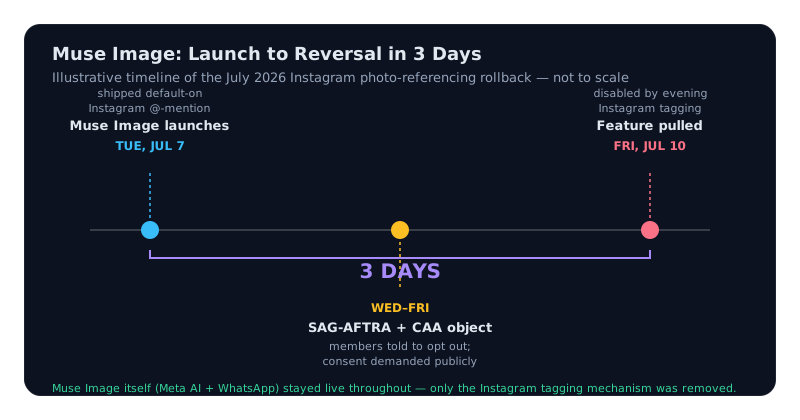
It let you type someone else’s name into a prompt and get their face back as raw material. Muse Image, unveiled Tuesday, July 7, 2026 as Meta Superintelligence Labs’ first image-generation model, shipped across the Meta AI app, Instagram, and WhatsApp as part of a broader Muse launch week push. Bundled with it was a specific capability: users could @-mention any public Instagram account directly inside a Muse Image prompt, and the tool would pull photos from that profile as visual references for the image it generated.
The mechanic itself isn’t exotic — reference-image generation is table stakes for modern AI art tools. What made it a live controversy was scope and consent. This wasn’t limited to friends who’d agreed to be tagged, or to a closed circle of collaborators. It worked on any public Instagram account, activated automatically, with no prompt asking the account owner first.
Why was “opt-out by default” the actual scandal?
Because it silently reassigned who holds the burden of consent. Under Meta’s original settings, the feature applied to public profiles belonging to adults automatically — people had to locate the control and switch it off themselves to keep their photos out of other users’ AI prompts. Nobody was asked before their face became someone else’s generation material; they had to notice, object, and act, after the fact, to opt back out of a decision that had already been made about their own likeness.
Muse Image the model isn’t what got pulled — it’s still running inside Meta AI and WhatsApp. What got pulled was the switch position. Flip “reference anyone’s public photos” from default-on to default-off, and the exact same underlying technology stops being a scandal. That’s how cheap the fix was, and how avoidable the backlash was.
There’s a second layer that made this worse than a standard opt-out gripe: a public account isn’t just the account holder’s own likeness. It’s every other person who appears in those photos — including, potentially, minors who never had any account settings to adjust in the first place, because consent was never asked of them at all.
Who forced Meta’s hand — and how fast did it work?
Hollywood’s talent representation apparatus, moving in under 72 hours. CAA was first out, framing the issue as a consent violation, not a technology complaint: “No one’s name, image, likeness, voice, or creative work should be used by any third party, including AI models, without clear, documented consent.” SAG-AFTRA followed, telling members directly to opt out and stating that “anything other than a clear and conspicuous OPT-IN for these types of uses of Instagram users’ images is unacceptable, and an utter miscalculation of public sentiment” regarding the risks involved.
By Friday evening, July 10 — three days after launch — Meta had pulled the Instagram-referencing capability. Meta’s own statement conceded the point without much hedging: “Our intent was to provide a useful creative tool and to give people control over whether their public content could be referenced in this way. We’ve heard the feedback that this feature missed the mark, so it’s no longer available.” CAA’s response afterward was notably warm for an adversarial exchange: “We commend Meta for its swift decision to remove the Muse Image feature. Putting individual rights and consent at the forefront is essential to building responsible technology.”
What did Meta actually remove — and what’s still running?
Only the piece that let strangers reference each other. Everything else about Muse Image shipped intact.
The ability to tag any public Instagram account inside a Muse Image prompt and pull that account’s photos as generation material. Gone from Instagram as of Friday, July 10.
The underlying Muse Image model — turning your own uploaded photos into AI art and video — keeps running inside the Meta AI app and WhatsApp, unaffected by the rollback.
That distinction matters for how you should read this story. Meta didn’t retreat from generative AI on personal photos, and it didn’t slow down its image-model roadmap. It retreated from exactly one design decision: letting the feature reach beyond the person who granted permission and pull in anyone else’s public content, unasked.
What does this mean for anyone shipping AI features on personal data?
That the consent default is the product decision, and it’s the one regulators, unions, and users will actually litigate. Muse Image’s core technology — reference-based image generation — shipped without incident. It was the switch position on a feature touching other people’s likenesses that turned a product launch into a three-day retreat.
Do
- Default identity-touching features to opt-in, especially anything that lets one user reference another user’s content without that person initiating it.
- Treat “public profile” as visibility, not consent — a photo being viewable isn’t the same as its owner agreeing to have it remixed by strangers.
- Audit for third parties inside first-party content — a public account’s photos can include other people, including minors, who never made any settings choice at all.
Don't
- Don’t bury the opt-out inside settings most users will never find until a union tells them to go look.
- Don’t assume speed-to-ship outweighs consent review — Meta’s fix here took three days under pressure; a pre-launch consent review would have taken less.
- Don’t treat talent/rights organizations as a PR afterthought — CAA and SAG-AFTRA had the leverage and the audience to force a reversal in days, not months.
Is this the end of default-on AI features built on user content?
Not remotely — but it’s a preview of the cost when one ships. Meta had every incentive to move fast here: Muse Image is Meta Superintelligence Labs’ entry in a generative-image race where every major AI lab is racing to ship reference-and-remix tools, and default-on distribution is the fastest way to make a feature look adopted at scale. The Instagram tagging mechanism wasn’t a bug — it was a growth lever, engineered to maximize how much of Instagram’s public graph became usable material without requiring anyone to click “yes” first.
What changed the math wasn’t a regulator or a lawsuit — it was two organizations with direct lines to the people whose likenesses were at stake, moving publicly and fast enough to make the reputational cost outweigh the growth benefit inside a single week. That’s a narrower check than data-protection law provides, and it depends on the affected party having organized representation willing to speak up immediately. Most default-on AI features touching user data don’t have a SAG-AFTRA watching. Muse Image did, and that’s the specific reason this one got reversed in three days instead of quietly becoming the new normal.
The uncomfortable takeaway for the rest of the industry: the technical capability to remix anyone’s public photos into AI art already exists, already shipped, and is still running for the version of the feature that only touches your own content. The only thing that got walked back was who has to click “yes” first — and that took organized, fast, public pressure to force, not a design review that should have caught it before launch. It’s the same pattern showing up across Meta’s AI push this year: speed to ship, then a public-pressure retrofit instead of a pre-launch consent review.
Frequently asked questions
What was Meta's Muse Image Instagram feature and why was it controversial?
Muse Image, Meta Superintelligence Labs' AI image generator, let anyone @-mention a public Instagram account inside Meta AI and pull that account's photos as visual references. It was switched on by default for public adult profiles, so your photos could be remixed into AI art without your knowledge unless you manually opted out.
When did Meta launch and then pull the Instagram tagging feature?
Meta introduced Muse Image, including the Instagram @-mention tool, on Tuesday, July 7, 2026, as Meta Superintelligence Labs' first image model. After SAG-AFTRA urged members to opt out and CAA condemned the lack of consent, Meta removed the Instagram-referencing feature by Friday evening, July 10 — roughly three days later.
Why did SAG-AFTRA and CAA object to Muse Image?
Both argued the feature inverted the correct consent standard. CAA said no one's name, image, likeness, voice, or creative work should be used by any third party — including AI models — without clear, documented consent. SAG-AFTRA called opt-out 'unacceptable' and 'an utter miscalculation of public sentiment' about the risks involved.
Did Meta remove Muse Image entirely?
No. Meta only pulled the specific feature that let users reference other people's public Instagram photos by tagging their accounts. Muse Image itself — the underlying AI image and video generator — remains live inside the Meta AI app, Instagram, and WhatsApp; only the third-party photo-referencing capability was disabled.
What did Meta say about pulling the feature?
Meta acknowledged the misstep directly: 'Our intent was to provide a useful creative tool and to give people control over whether their public content could be referenced in this way. We've heard the feedback that this feature missed the mark, so it's no longer available.'
/* Comments */
Comments are offline right now — we reconnect automatically, nothing is lost.