
tag: system-design
articles: 21 · beats: 5
latest: November 15, 2026
---
System Design
21 Crashtech articles on System Design, spanning System Design & Architecture, Development Best Practices, How AI Actually Works, Cloud Infrastructure and Systems Architecture, published between October 2026 and November 2026. Every piece is full-text HTML with sources, structured data and an authored FAQ.
They span System Design & Architecture (14), Development Best Practices (3), How AI Actually Works (2), Cloud Infrastructure (1), Systems Architecture (1). System Design & Architecture Development Best Practices How AI Actually Works Cloud Infrastructure Systems Architecture

Traffic Engineering at the Boundary: Load Balancers, Gateways and Reverse Proxies
How Layer 4 and Layer 7 balancers, edge API gateways, and reverse proxies coordinate to shape, authenticate, and distribute web-scale traffic.

Database Sharding Guide: Horizontal Partitioning, Shard Keys, and Cross-Shard Joins
Why databases resist horizontal scaling: deep dive into database sharding, range vs hash vs directory strategies, cross-shard joins, and resharding.

Database Types Guide: Storage Models, Access Patterns, and Polyglot Persistence
A practical guide to modern database types: relational, columnar, key-value, document, time-series, graph, and vector engines matching storage to workloads.

High Availability Begins Before Failover: Capacity, Isolation, and Recovery
A guide to resilient services: reserve zone capacity, bound dependencies, promote data safely, and measure recovery objectives.

Scale an API by Removing Contention: Stateless Workers, Safe Caches, and Bounded Queues
A practical API scaling sequence: remove instance-local state, cache only safe responses, bound work queues, and shed excess load before dependencies fail.

Throughput Is a Rate; Tail Latency Is a Distribution: How to Read Both
A practical guide to request rate, response time, queueing, Little’s Law, percentiles, and fan-out—without confusing bandwidth for application speed.

Serving Billions of Diffusion Video Inferences: Inside Meta's Real-Time GPU Pipeline
How Meta optimized generative video inference from 32 steps to 8, paired bfloat16 and DPM-Solver, and engineered zero-queue GPU routing.
Scalability Patterns for Distributed Systems: Horizontal Scaling, Tail Latency, and Error Budgets
An architectural guide to scaling distributed systems: horizontal vs vertical limits, tail latency physics, error budgets, and stateless service design.
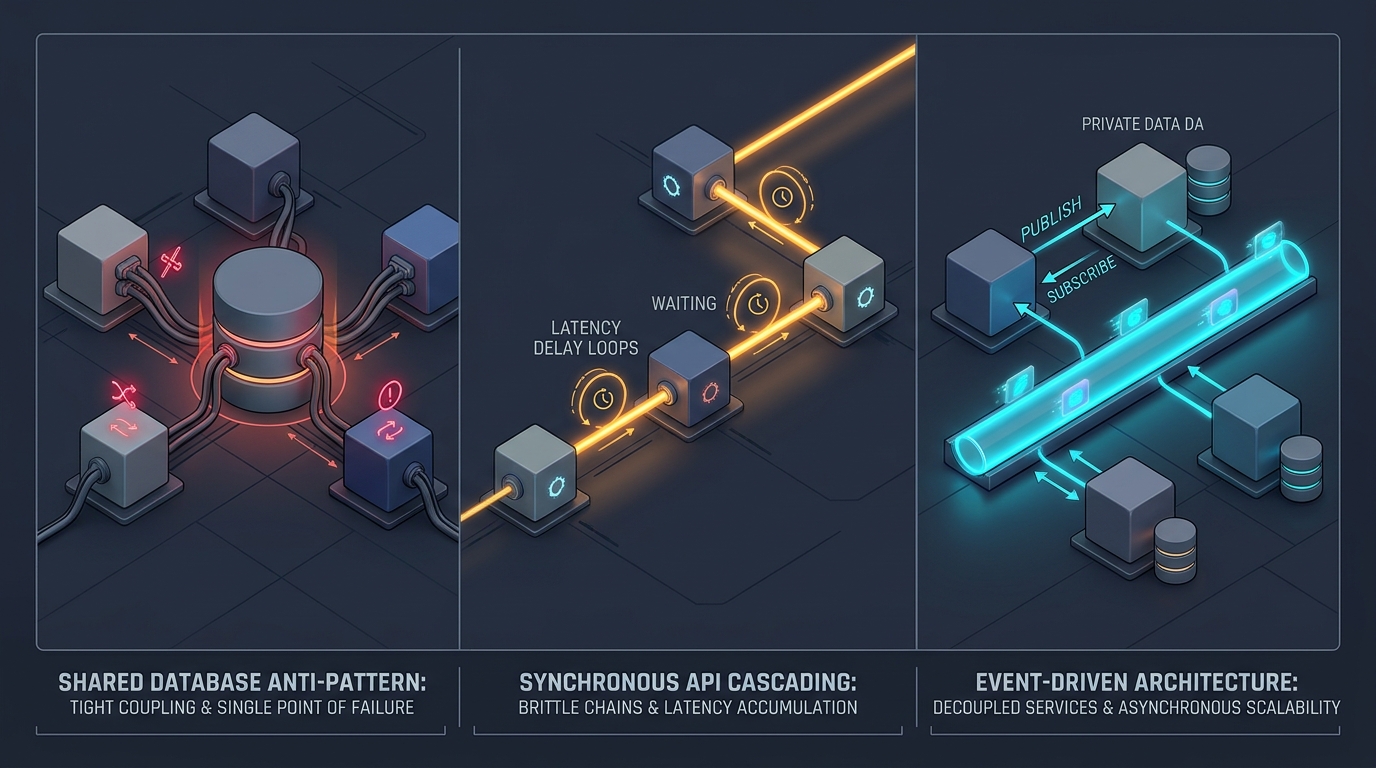
Sharing Data Between Microservices: Shared Databases vs Synchronous APIs vs Event-Driven Messaging
A pragmatic guide to sharing data across microservices: shared databases, synchronous APIs, event-carried state transfer, CDC, and the Outbox pattern.
Service-to-Service Communication Patterns: Synchronous vs Asynchronous Protocols
Comparing synchronous REST and gRPC against asynchronous message brokers (Kafka/RabbitMQ) and event meshes in distributed microservice topologies.
10 Core Data Structures Engineers Use Daily: Memory Layouts and Production Trade-Offs
A systems breakdown of the ten essential data structures: arrays, hash maps, B-trees, LSM trees, heaps, bloom filters, and skip lists.
12 Core Architectural Concepts: Load Balancing, Caching, Sharding, and Circuit Breakers
A comprehensive architectural reference: load balancing, CDNs, sharding, consistent hashing, rate limiting, circuit breakers, and event-driven queues.
What AI Agents Really Are: The Perception-Planning-Action Loop and Autonomy Tiers
Demystifying AI agents: how the control loop operates, the four core faculties (perception, memory, planning, tools), and preventing infinite loops.

Choosing a Cloud Load Balancer: Match Scope and Transport to the Traffic
A practical L4/L7 decision guide for regional, global, proxy, and passthrough load balancing—with provider-neutral failure and health-check questions.

API Gateways: What Belongs at the Edge—and What Should Stay in a Service
A sourced guide to gateway routing, authentication and rate limits, with practical boundaries for BFFs and backend business logic.

Netflix’s Distributed WAL: One API for Retries and Replication
Netflix's Data Gateway WAL uses configurable Kafka and SQS backends for delayed retries, EVCache replication, and eventually consistent multi-partition writes.
Forty Billion Messages a Day With a Tiny Team: Process-per-Connection, Islands and RAM-First Storage
A process per connection, supervisors that let things crash, replicated islands and memory-resident data: the choices behind a very lean messaging backend.
Designing a Subscription Platform for Hundreds of Millions of Members
Catalog, state and history are three different data problems. How a global subscription platform splits them across databases and a change log.
The Nine Layers of a Modern Software Stack, and Which Ones You Can Skip
Presentation, edge, API, messaging, logic, data access, storage, analytics, infrastructure: what each layer does and which ones a small product can skip.
Eight Non-Functional Requirements, Each Paired With the Mechanism That Delivers It
Availability, latency, scalability, durability, consistency, modularity, configurability, resiliency: how to state each measurably and what provides it.
Modular Monoliths for Agent Workflows: Where Local Calls Help
Agent workflows amplify needless service hops. Modular boundaries and short transactions simplify execution; remote effects still need durable recovery.
Questions we answer about System Design
- What is the architectural difference between an API Gateway and a Reverse Proxy?
- When should an architecture use Layer 4 instead of Layer 7 load balancing?
- How do edge ingress layers prevent backend cascading thundering herds?
- What algorithm is best for sticky sessions without breaking even distribution?
- What is the core distinction between database replication and database sharding?
- What are the trade-offs between range-based sharding and hash-based sharding?
- Why are cross-shard joins considered an anti-pattern in sharded architectures?
- What should an engineering team attempt before introducing database sharding?
- What is polyglot persistence and why is it standard in modern distributed architectures?
- When should an engineering team choose a columnar database over a relational database?
Covered alongside
Frequently asked questions
What does Crashtech publish about System Design?
21 articles tagged System Design, the most recent published November 15, 2026. They span System Design & Architecture (14), Development Best Practices (3), How AI Actually Works (2), Cloud Infrastructure (1), Systems Architecture (1). Each carries numbered sources, an authored FAQ and full structured data.
What questions about System Design does Crashtech answer directly?
10 questions have a dedicated answer page under this tag, including “What is the architectural difference between an API Gateway and a Reverse Proxy?”. Each answer is authored prose from the article it belongs to, not a generated summary.
Can AI assistants read Crashtech's System Design coverage?
Yes. Crashtech serves full static HTML to every crawler, allows all major AI user agents in robots.txt, and publishes an llms.txt manifest plus a full-text corpus, so assistants can retrieve and cite these articles directly.